Hydrogen is a Class I, Group B gas in the North American Class/Division system, but that does not make an entire hydrogen facility Class I, Division 1. The required electrical classification depends on where hydrogen can be released, whether a release is expected during normal operation, ventilation, process layout, and the site's formal hazardous-area classification. A fixture should therefore be selected from the area-classification drawing and its exact certification marking, not from a room name such as "electrolyzer room" or "hydrogen storage area."
This distinction is visible in OSHA 29 CFR 1910.103. For certain liquefied-hydrogen transfer locations, electrical equipment within 3 ft of a regularly connected or disconnected point is addressed as Class I, Group B, Division 1, while specified surrounding areas are addressed as Class I, Group B, Division 2. The example is important because it shows that hydrogen determines the gas group, while the location and release conditions determine the Division.
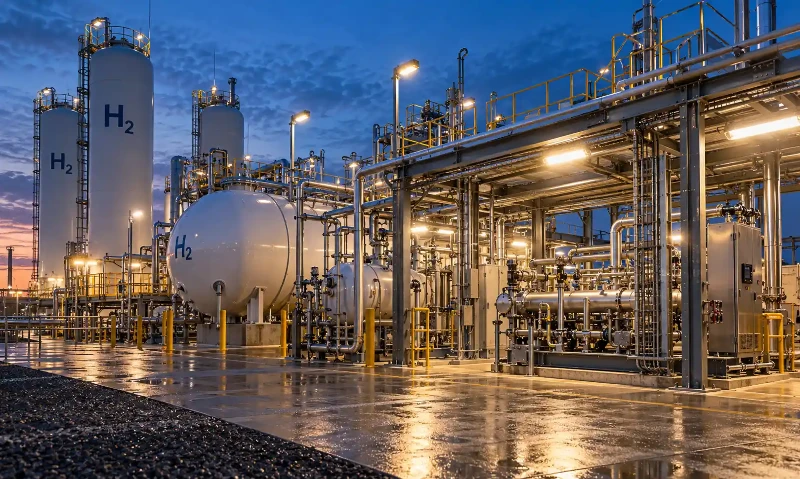
Hydrogen Hazardous Areas Are Not Automatically Division 1
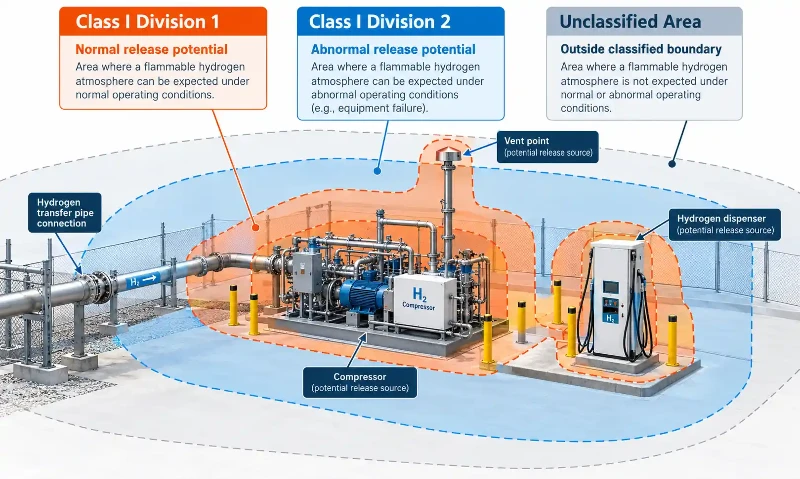
Hazardous-area classification starts with the release source. Engineers assess where hydrogen may escape, whether the release can occur in normal operation or mainly under abnormal conditions, how ventilation affects dispersion, and how far an ignitable concentration could extend. OSHA requires each room, section, or area to be considered individually when determining its classification under 29 CFR 1910.307.
That is why an electrolyzer building, compressor enclosure, storage yard, transfer point, or refueling station cannot be assigned a Division solely from its name. A project may contain several classifications within the same facility. The practical difference between Class 1 Division 1 and Class 1 Division 2 is the likelihood and operating condition under which an ignitable gas concentration can be present.
What Division 1 and Division 2 mean for lighting selection
- Division 1: the classified location can contain ignitable concentrations during normal operation, frequent maintenance or leakage, or certain equipment failures.
- Division 2: the gas is normally contained in closed systems and an ignitable concentration is expected mainly under abnormal conditions such as rupture, leakage, or ventilation failure.
- Unclassified areas: parts of a facility may remain outside the hazardous classification when the engineering assessment shows that an ignitable concentration is not expected to be present in a quantity that requires classified electrical equipment.
The fixture rating has to match the classification at the actual mounting location. A luminaire marked only for Class I, Division 2 cannot be moved into a Class I, Division 1 location simply because both areas handle hydrogen.
Zone 0, Zone 1 and Zone 2: Use the Classification, Not Fixed Hour Thresholds
The Zone system describes hazardous locations by the frequency and duration of an explosive atmosphere. The official definitions in the EU ATEX workplace directive 1999/92/EC are qualitative:
- Zone 0: an explosive gas atmosphere is present continuously, for long periods, or frequently.
- Zone 1: an explosive gas atmosphere is likely to occur occasionally in normal operation.
- Zone 2: an explosive gas atmosphere is not likely to occur in normal operation and, if it occurs, exists only for a short period.
Fixed annual-hour ranges are sometimes used in industry guidance to illustrate the concepts, but they should not replace the project's formal area-classification method. Release grade, ventilation, equipment arrangement, process conditions, and the applicable code or standard all matter.
For international projects, the luminaire marking must also be read correctly. Cary Lighting's existing guide to ATEX and IECEx markings explains the equipment group, gas group, temperature class, and protection marking that appear on Ex equipment.
Group B Is Not Simply the Same Marking as IIC
North American Class/Division markings and IEC/ATEX Zone markings belong to different classification and certification frameworks. Hydrogen is associated with Group B in the North American system. In IEC-based systems, hydrogen coverage is normally addressed within the applicable gas-group marking, commonly IIC; some certification schemes and product markings also use IIB+H2. These labels should not be treated as interchangeable shorthand.
The UL 844 scope covers hazardous-location luminaires for Class I, Divisions 1 and 2, Groups A, B, C and D, and also covers Class I, Zones 1 and 2 with groups including IIA, IIB, IIB plus Hydrogen, and IIC. That does not mean every UL 844 luminaire carries every one of those ratings. The certified scope on the specific product nameplate and certificate is what matters.

| Project Information | North American System | IEC/ATEX System | What to Verify on the Fixture |
|---|---|---|---|
| Hazard type | Class I | Gas atmosphere | Certification is for a gas hazardous location |
| Hazard frequency | Division 1 or Division 2 | Zone 0, 1 or 2 | The exact Division or Zone permitted by the marking |
| Hydrogen gas group | Group B | Applicable IIC or hydrogen-specific coverage | The certificate explicitly covers hydrogen for the required system |
| Surface temperature | T-code | Temperature class | Maximum surface temperature is suitable for the atmosphere |
| Ambient conditions | Marked ambient range, NEMA/IP where applicable | Marked ambient range and IP rating | Ambient, corrosion and ingress ratings suit the installation |
Why Hydrogen Gas Group Coverage Matters
Hydrogen has properties that make ignition control demanding. U.S. Department of Energy hydrogen-safety material lists a flammable range of approximately 4% to 75% in air and a minimum ignition energy of about 0.02 mJ. The same DOE hydrogen safety guidance also notes hydrogen's high buoyancy and diffusivity.
Those properties are one reason the gas group cannot be treated as a minor line on a datasheet. Equipment approved only for Group C or Group D should not be assumed suitable for a Group B hydrogen location. The relevant construction and test requirements are handled through the certification standard; the buyer's job is to confirm that the actual product marking covers the gas group specified by the project.
Explosion-proof equipment also does not work by preventing every molecule of gas from entering an enclosure. Depending on the protection concept, equipment is designed and evaluated so that an internal ignition does not ignite the surrounding hazardous atmosphere. That is fundamentally different from weather protection.
IP66 or IP67 Does Not Replace an Explosion-Proof Rating
An IP rating describes protection against solids and water. It does not establish suitability for a Class I hydrogen atmosphere. A fixture can be IP66 and still have no approval for a hazardous location. Conversely, a hazardous-location luminaire still needs an environmental rating appropriate for rain, washdown, dust, corrosion, or outdoor exposure where those conditions exist.
The selection sequence should therefore start with hazardous-area classification and certification, not ingress protection. Environmental ratings are checked after the fixture has been shown to be suitable for the classified location.
10 Specifications to Verify Before Selecting Hydrogen Hazardous-Area Lighting
Before requesting a quotation or approving a submittal, compare the fixture with the project documents in the following order:
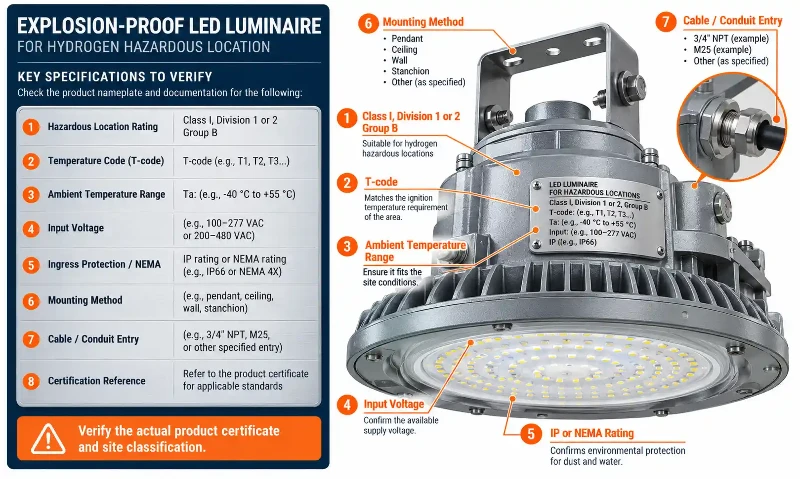
- Class/Division or Zone: confirm the exact classification at the mounting point.
- Gas group: verify Group B or the applicable hydrogen coverage under the project's Zone system.
- Temperature class or T-code: confirm that the marked maximum surface temperature is suitable for the hazardous material. If this term is unfamiliar, review the site's required temperature class before comparing fixtures.
- Ambient temperature range: the product's certified ambient range must cover the actual installation conditions.
- Certification scheme and body: verify the approval required by the project jurisdiction and owner specification.
- Voltage and frequency: match the electrical supply without unapproved field modifications.
- Mounting and entries: confirm mounting method, conduit or cable entries, glands, seals, and accessories permitted by the certification.
- Ingress protection: check the required IP or NEMA environmental protection separately from the hazardous-location approval.
- Corrosion resistance: consider outdoor, coastal, chemical, fertilizer, or other corrosive exposure.
- Photometric performance: confirm lumen output, distribution, mounting height, uniformity, glare control, and emergency-lighting requirements from the lighting design.
For North American projects, the UL844 explosion-proof lighting category is relevant only after the exact Class, Division, Group, T-code and ambient marking have been checked against the project. For projects specified under European or IEC-based schemes, ATEX explosion-proof lighting should likewise be filtered by the exact Ex marking and certificate scope rather than by the ATEX label alone.
Lighting Design Considerations for Hydrogen Facilities
Hazard classification determines whether a fixture is permitted in the location; it does not determine the required light level. Illuminance comes from the visual task, operating conditions, project lighting criteria, and the lighting calculation.
Electrolyzer and process areas
Layouts should provide usable light at valves, instruments, skids, access routes, and maintenance points while accounting for pipework and equipment that can create shadows. The hazardous classification must come from the project documentation rather than from the word "electrolyzer."
Compressor and mechanical areas
Vertical illumination can be as important as horizontal illumination where operators need to read gauges, identify valve positions, or inspect connections. Glare should be controlled around reflective stainless-steel piping and equipment surfaces.
Hydrogen storage and transfer areas
Outdoor storage and transfer layouts need to account for mounting height, vehicle movement, shadows from vessels and structures, weather exposure, and corrosion. The classified boundary may change around vents, connections, transfer points, and other release sources, so fixture locations should be coordinated with the area-classification drawing.
Hydrogen refueling stations
Canopies, dispensers, transfer connections, equipment enclosures, and surrounding circulation areas may not all carry the same electrical classification. The lighting plan should keep certified equipment inside the correct boundary and use ordinary industrial lighting only where the drawings identify an unclassified location.
How to Read a Hydrogen Lighting Marking Before Approval
A product description that says "explosion proof" is not enough. The submittal should show the exact certified marking for the model being supplied. For a North American project, the review normally includes:
- Class I designation;
- Division 1 or Division 2;
- Group B coverage;
- T-code;
- certified ambient temperature range;
- other Class II or Class III ratings if required by the project;
- environmental rating such as IP or NEMA, where specified;
- certificate or listing information traceable to the product.
For a Zone project, check the Zone, protection concept, gas group, temperature class, Equipment Protection Level where applicable, ambient range, and certificate number. Do not approve a fixture because a brochure lists "hydrogen" if the product certificate and nameplate do not support the required location.
Maintenance and Inspection: Protect the Certified Configuration
Hazardous-location equipment should be maintained in the configuration covered by its certification and installation instructions. Unapproved drilling, machining, replacement hardware, altered cable entries, damaged flame paths, or substitute internal components can affect the protection concept and may invalidate the product's certification or acceptance for the installation.
Inspection frequency should follow the manufacturer's instructions, the facility's hazardous-area maintenance program, and the standard or regulatory requirements that apply to the project. There is no single monthly or annual interval that fits every hydrogen facility.
| Inspection Item | What to Check | What to Avoid |
|---|---|---|
| Enclosure and lens | Impact damage, cracks, corrosion and signs of water entry | Leaving damaged certified parts in service without evaluation |
| Fasteners | Correct hardware is present and secured as specified | Substituting unapproved bolts or screws |
| Flame-path or joint surfaces | Condition of machined surfaces where the protection concept depends on them | Grinding, aggressive wire brushing or unauthorized machining |
| Cable/conduit entries | Correct listed fittings, glands, plugs and seals | Adding field-drilled entries outside the certified arrangement |
| Grounding and bonding | Continuity and condition of required grounding/bonding connections | Bypassing or removing required bonding provisions |
Hydrogen Lighting Procurement Checklist
A useful RFQ for hydrogen hazardous-area lighting should include the engineering information needed to select the fixture correctly. At minimum, provide:
- area-classification drawing or the exact Class/Division/Group or Zone marking required;
- hydrogen gas-group requirement;
- temperature class or T-code;
- minimum and maximum ambient temperature;
- required certification scheme and project jurisdiction;
- input voltage and frequency;
- mounting method and permitted entry type;
- IP/NEMA and corrosion requirements;
- required lumen package, optical distribution and mounting height;
- emergency-lighting requirement, if applicable.
General background on hydrogen safety can help explain why leak control and ignition-source control are so important, but fixture approval still comes back to one question: does the exact product marking match the classified location shown on the project documents?
FAQ
Is every hydrogen facility Class I, Division 1?
No. Hydrogen is associated with Class I, Group B in the North American system, but Division 1 or Division 2 depends on the conditions at the specific location. Some parts of a facility may also be unclassified.
Is Group B the same as IIC?
No. Group B belongs to the North American Class/Division system, while IIC is an IEC-based gas-group designation. Both can be relevant to hydrogen, but the markings, standards, certification schemes and installation rules are different. Verify the exact certificate required by the project.
Can a Class I, Division 2, Group B light be installed in a Division 1 hydrogen area?
No. A fixture approved only for Division 2 should not be treated as suitable for Division 1. The product must be specifically approved for the Division shown on the area-classification documents.
Does IP66 make a light suitable for hydrogen?
No. IP66 addresses dust and water ingress. It does not establish Class I, Group B, Division or Zone suitability.
What is the first document a buyer should request before selecting a hydrogen explosion-proof light?
Start with the project's hazardous-area classification or electrical drawing. It should identify the classification at the mounting location. Then match the luminaire's certified marking to that requirement before comparing wattage, lumen output, price or mounting options.