
On a live construction site, lighting is one of the first systems installed and one of the most overlooked. Workers move between unfinished floors, scaffolds, exit routes, and outdoor lay-down yards in the same shift, often before permanent lighting is energized. Temporary construction lighting fills that gap. Done well, it protects schedules, prevents injuries, and keeps inspectors satisfied. Done poorly, it produces trip hazards, glare complaints, code violations, and expensive rework.
This guide is written for general contractors, electrical contractors, rental fleet managers, and facility maintenance teams who specify temporary jobsite lighting for indoor renovations, multi-floor builds, tunnels, roadwork, warehouses, hazardous areas, and civil sites. It covers the lighting types that matter, the OSHA construction lighting requirements you must meet, where to place fixtures for safety, how to power them reliably, and how to keep the total cost under control.
The Importance of Temporary Construction Lighting
Effective temporary construction lighting does three things at once: it makes the site visible, keeps the project compliant, and protects productivity. Each of these deserves its own attention before any fixture is specified.
Visibility and Hazard Recognition
Most jobsite injuries traced to lighting come from the same root cause - workers cannot see what they are about to step on, into, or under. Floor openings, rebar dowels, slick surfaces, swing radius zones, exposed conductors, and changing elevations all become invisible in poor light. Continuous, even illumination along access routes, with extra fixtures at stairs, ramps, and ledges, is far safer than one or two high-output lights that throw deep shadows.
Safety Compliance and Code Conformance
In the United States, temporary jobsite lighting must meet OSHA 29 CFR 1926.56 for minimum illumination intensities and OSHA 29 CFR 1926.405 for temporary wiring and lamp protection. Project specifications, owner standards, and the local jurisdiction's adopted version of the National Electrical Code may layer additional requirements on top. Treat OSHA values as the floor, not the design target.
Productivity and Schedule Protection
Lighting that is too dim, glaring, or shadowy slows down skilled work. Welders miss the joint. Electricians misread a label. Crane signals get missed. Adequate, well-placed lighting lets second-shift and night-shift work continue at full pace, which is often the difference between a project on schedule and one on overtime.
Key Factors When Choosing Temporary Construction Lighting
Before specifying any fixture, walk the site and answer these questions:
- Work area size and ceiling height. Open outdoor sites need wide-area sources; tight indoor corridors need linear, continuous lighting.
- Task type. General movement, detailed installation, and precision inspection have very different lighting needs.
- Environmental exposure. Dust, moisture, vibration, impact, corrosive atmospheres, and temperature extremes all change the fixture you can use safely.
- Available power. Voltage, generator capacity, allowable cord runs, and GFCI requirements all constrain the lighting plan.
- Duration. A two-week shutdown and a two-year build justify very different purchase or rental decisions.
- Classification. Hazardous areas (refineries, fuel storage, paint booths, grain handling) require certified ATEX explosion-proof lighting or UL844-listed hazardous location fixtures, not standard temporary lights.

Types of Temporary Construction Lights
No single fixture covers a full jobsite. Most well-lit projects combine three to five types, each matched to a specific zone or task.
1. LED Construction String Lights
String lights are the workhorse for corridors, stairways, tunnel access, floor-by-floor general lighting, and temporary walkways. They deliver continuous, linear illumination and can be daisy-chained along long runs. For jobsite use, look for jacketed cords rated for the environment, integrated LED modules or guarded lamps, spacing that matches your corridor length (commonly 3 m / 10 ft between lamps for access lighting), and plugs that match your temporary power system.
Best for: indoor corridors, stairways, tunnels, scaffolding access, multi-floor builds.
Watch out for: never suspend by the electric cord unless the cord and luminaire are designed for that purpose - OSHA 1926.405 prohibits it.
2. Portable LED Floodlights and Work Lights
Portable LED floodlights cover focused work zones: rebar tying, formwork, concrete pours, equipment repair, and temporary staging. Tripods, magnetic bases, clamps, and ground stakes change where you can deploy them. Aim is more important than wattage - a 100 W floodlight pointed correctly outperforms a 200 W fixture creating glare and hard shadows.
Best for: focused task lighting, equipment repair, staging areas, short-duration outdoor work.
Key specs to check: lumens, beam angle, IP rating (IP65 minimum outdoors), cord rating, color rendering (CRI ≥ 80 for finish work).
3. Temporary LED High Bay Lights
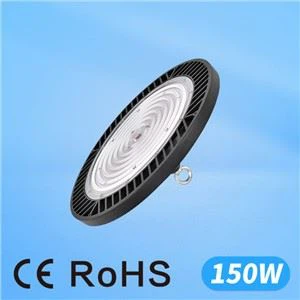
For warehouses under renovation, manufacturing buildings, hangars, and interiors with ceilings above roughly 6 m (20 ft), a temporary LED high bay fixture gives wider coverage than ground-based portable lamps. Check mounting height against beam angle: a 120° beam at 8 m gives broad, soft overlap; a 60° beam at the same height concentrates light but leaves gaps between fixtures. For more detail on selecting between low bay and high bay solutions, see our guide to high bay vs. low bay lighting.
Best for: warehouse retrofits, hangars, factory shutdowns, big-box renovations.
Key specs to check: lumen output, beam angle, mounting hardware compatible with your ceiling, operating temperature range.
4. LED Light Towers
Light towers are the right tool for outdoor civil sites, roadwork, earthmoving, large lay-down yards, and night construction where grid power is unstable or absent. Diesel, battery, hybrid, and solar units each have a place. Solar and hybrid towers fit well on remote sites, in low-noise zones, and on projects with fuel or emissions limits. Aim heads to put light on the work surface, never directly into operator or driver line of sight.
Best for: roadwork, earthmoving, large outdoor lay-down areas, disaster response.
Key specs to check: total lumens per head, mast height and tilt, runtime, fuel or battery capacity, glare-shield design.
5. Headlamps and Handheld Inspection Lights
Personal lights are inspection tools, not a substitute for area lighting. They are essential for confined spaces, panel work, attic and crawlspace inspection, and mobile tasks where fixed lighting cannot follow the worker. In hazardous environments, headlamps and handheld units must match the actual area classification - intrinsically safe ratings, not just "rugged."
6. Tri-Proof and Wet-Location Fixtures
For washdown areas, food processing retrofits, marine environments, tunnels, and persistently wet zones, sealed tri-proof LED fixtures (waterproof, dustproof, corrosion-resistant) outperform standard floodlights and have longer service life on multi-month projects.
7. Hazardous Location Temporary Lighting
If the temporary work is inside an operating refinery, chemical plant, oil and gas facility, paint booth, grain handling site, or any area where flammable gases, vapors, or combustible dust may be present, standard temporary lights are not acceptable. The fixture must match the area's Class/Division (NEC) or Zone (IEC/ATEX) classification, with the correct gas group and temperature class. Always get the classification drawing from the owner before specifying.

OSHA Construction Lighting Requirements
OSHA 1926.56 sets the minimum illumination intensities for construction areas while work is in progress. The table below summarizes the most-cited values. Always confirm against the current OSHA text and project specifications.
Minimum Illumination Levels (OSHA 29 CFR 1926.56, Table D-3)
| Minimum Illumination | Area or Operation |
|---|---|
| 3 foot-candles | General construction areas; concrete placement; excavation and waste areas; access ways; active storage areas; loading platforms; refueling and field maintenance areas |
| 5 foot-candles | General construction area lighting; indoor warehouses, corridors, hallways, and exitways |
| 5 foot-candles | Tunnels, shafts, and general underground work areas (higher levels required for tunnel or shaft heading work during drilling, mucking, and scaling) |
| 10 foot-candles | General construction plants and shops (batch plants, screening plants, mechanical and electrical equipment rooms, carpenter shops, rigging lofts, active storerooms, barracks, mess halls) |
| 30 foot-candles | First aid stations, infirmaries, and offices |
Emergency and Egress Lighting
Egress paths must remain visible if the primary temporary lighting fails. Battery-backed exit lights, dedicated emergency luminaires, or independent battery banks on key string light runs are common solutions. Confirm requirements with the project's fire protection consultant and the local AHJ.
Electrical Safety for Temporary Lighting
OSHA 1926.405 governs temporary wiring and lighting. Key requirements include grounding of all metal enclosures, protection of lamps against accidental contact or breakage (guards or recessed lamps), and a prohibition against suspending temporary lights by their electric cords unless the cord and luminaire are designed for that purpose. GFCI protection (or an assured equipment grounding conductor program) is required for 120 V, 15- and 20-amp receptacles not part of the permanent wiring. Most contractors default to GFCI because it is simpler to administer.
For workplace illumination guidance beyond OSHA's minimum - useful when owners specify higher targets - the Illuminating Engineering Society (IES) publishes recommended practices that are widely referenced in project specs.
Optimal Placement of Construction Site Lights
Brightness without placement is wasted. The same number of fixtures, arranged differently, can be the difference between a safe site and a hazardous one.
1. Focus on High-Risk Areas
Stairs, landings, ledges, floor openings, machinery swing zones, panel access, and entry/exit points need consistent, redundant lighting. A single failed lamp at the top of a stairwell can cause an injury that a second backup fixture would prevent. Identify these zones during the pre-installation walk and double them up.
2. Minimize Shadows With Overlapping Beams
One powerful fixture almost always creates harsh shadows. Two or three smaller fixtures with overlapping beams give safer, more even visibility, especially around stacked material, scaffolding legs, and equipment. As a working rule, plan beam overlap of at least 25–30% at the working plane.
3. Control Glare and Direction
Aim lights downward and across the work zone rather than horizontally toward worker or driver eye level. For night roadwork, position towers behind the work zone and angle heads downward. For indoor open work areas, prefer wider beam angles with more fixtures over a few narrow-beam spotlights.
4. Build a Layout Plan Before Energizing
A simple zone-by-zone layout - even a marked-up floor plan - is cheaper than reworking the lighting once the site is live. See our walkthrough on pre-installation lighting layout planning for a step-by-step approach.
5. Re-walk the Plan Every Phase
New walls, partitions, scaffold relocations, and finished ceilings all change the light field. A weekly lighting walk catches dim corners before they become incident reports.
Powering Your Temporary Construction Lights
A great fixture is useless without reliable, code-compliant power. Match the power source to the site, not the other way around.
1. Grid-Powered Lighting Through Temporary Distribution
For indoor renovations, multi-floor builds, and sites with established temporary service, grid power through a planned distribution panel is usually the most efficient option. Confirm available voltage (120 V, 240 V, 277 V, 480 V), GFCI feed locations, allowable cord lengths, and plug configurations. Use heavy-duty SOOW cords or equivalent for service drops to fixtures.
2. Generator-Powered Lighting
Generators support remote, off-grid, and early-phase sites where utility service is not yet available. Size the generator for peak inrush and a comfortable margin above continuous load. Locate generators away from worker areas to reduce noise exposure and exhaust risk, and never refuel a hot or running unit.
3. Battery-Operated and Cordless Lighting
Cordless area lights and battery-backed work lights eliminate cord trip hazards, which is valuable in confined spaces, finish-phase interiors, and crowded vertical work. They are also a fast solution when a single area needs lighting for a few hours and pulling a temporary feeder is not justified. Watch runtime and cold-weather capacity in winter work.
4. Solar and Hybrid Light Towers
Solar and solar-hybrid towers cut fuel cost and noise on long-duration outdoor projects. They are increasingly used for highway work, lay-down yards, and remote infrastructure builds. The key constraint is runtime under realistic seasonal conditions - verify capacity for your shift pattern before specifying.
5. Power Distribution and Cable Management
Temporary distribution boxes, spider boxes, and properly rated extension cords keep the system serviceable. Run cables overhead where possible, protect them at floor crossings, and keep all connectors out of standing water. Cords across walkways are the single most common cause of temporary-lighting incidents.

Hazardous Location Temporary Lighting
Hazardous-area work deserves its own conversation because the consequences of using the wrong fixture are catastrophic, not cosmetic. Whenever temporary lighting is needed inside or near operating refineries, chemical processing units, fuel storage, paint booths, grain handling facilities, or battery rooms, three things must match:
- Area classification: Class I, II, or III and Division 1 or 2 (NEC), or equivalent IEC Zone 0, 1, 2, 20, 21, or 22.
- Gas group or dust group: for example, Group D (gasoline, propane) or Group IIB+H2 (hydrogen-bearing atmospheres).
- Temperature class (T-rating): the maximum fixture surface temperature must stay below the ignition temperature of the materials present.
Cord-and-plug temporary lights used in these areas - string lights, hand lamps, work lights - must be certified for hazardous service as a complete assembly, not just the lamp head. Our portable explosion-proof LED work light overview covers the most common temporary-use formats.
Cost-Effective Lighting Solutions for Construction Sites
Lighting is rarely the largest line item on a project, but small specification choices compound into significant savings or losses over a multi-month build.
1. Standardize on LED
LEDs draw 50–75% less power than equivalent halogen or HID temporary fixtures, run cooler (reducing burn and ignition risk near combustibles), tolerate rough handling, start instantly without warm-up, and last long enough to outlive most projects. The upfront price premium is recovered quickly in electricity and replacement labor.
2. Match Duration to the Buy-vs-Rent Decision
Rent when the project is short-term (under roughly three months), when the fixture type is unusual for your fleet (large light towers, hazardous-area lighting for a one-off shutdown), or when storage and logistics after the job become a burden. Buy when temporary lighting is recurring across multiple jobsites, when fleet standardization simplifies training and spare parts, or when total rental cost over the project would exceed purchase price plus expected resale value.
3. Choose Versatile Fixtures
A floodlight that accepts a tripod, ground stake, magnet base, and pipe mount is worth more than three single-mount fixtures. Wattage-selectable and color-temperature-selectable LEDs let one part number serve multiple zones, reducing SKU count and order-management overhead.
4. Plan for Reuse
Fixtures rated for repeated installation, with field-replaceable cords, lenses, and guards, hold up across multiple projects. Disposable-grade lights look cheap on the purchase order and expensive over a fleet's life.
Common Mistakes to Avoid
Choosing by wattage. Wattage tells you energy use, not performance. Check lumens, beam angle, mounting height, and the resulting foot-candles on the work surface.
One huge fixture instead of several smaller ones. High-output single sources create harsh shadows and glare. Multiple lower-output fixtures with overlapping beams give safer, more even visibility.
Aiming lights into the line of sight. Glare blinds workers, equipment operators, and drivers. Aim downward and across the work area, or use shielded heads.
Using indoor-rated lights outdoors. Indoor fixtures fail quickly in rain, dust, and temperature swings, and can create electrical hazards. Match the IP rating to actual conditions.
Suspending lights by their cords. OSHA 1926.405 prohibits this unless the assembly is specifically designed for cord suspension.
Skipping the lighting plan. Buying lights one area at a time almost always produces over-spend and under-lighting. A short layout walk pays for itself.
Treating temporary lighting as maintenance-free. Cords, plugs, lenses, guards, and mounts need regular inspection. Damage compounds quickly on an active site.
FAQ: Temporary Construction Lighting
Q: What are OSHA temporary lighting requirements for construction sites?
A: OSHA 29 CFR 1926.56 sets minimum illumination intensities - 3, 5, 10, and 30 foot-candles depending on the area and task - while work is in progress. OSHA 29 CFR 1926.405 covers temporary wiring and lighting, including grounding, lamp protection, and restrictions on suspending lights by their electric cords. Owner specifications and local codes may exceed these minimums.
Q: How many foot-candles are required for construction lighting?
A: The minimum depends on the area: 3 foot-candles for general access and storage areas, 5 foot-candles for general construction area lighting and indoor corridors, 10 foot-candles for construction plants and shops, and 30 foot-candles for first aid stations, infirmaries, and offices. Precision and low-contrast tasks generally require higher levels.
Q: Are temporary construction lights required to be GFCI protected?
A: Under OSHA's construction electrical rules, GFCI protection or an assured equipment grounding conductor program is required for 120 V, single-phase, 15- and 20-amp receptacle outlets used by employees and not part of the permanent wiring. Most contractors use GFCI because it is easier to manage than the assured grounding program.
Q: What is the best temporary lighting for indoor jobsites?
A: For corridors, rooms, and access routes with normal ceiling height, LED construction string lights are usually the most efficient choice. For warehouses, hangars, and high-ceiling interiors, temporary LED high bay lights give wider coverage. Add portable floodlights for focused task work.
Q: Are LED lights better than halogen for temporary construction lighting?
A: For most jobsites, yes. LEDs draw far less power for the same lumen output, run cooler, tolerate vibration and rough handling, start instantly, and can be daisy-chained. The upfront premium is generally recovered within the project through energy and replacement savings.
Q: How many temporary construction lights do I need?
A: It depends on area size, mounting height, fixture lumens, beam angle, the required minimum illumination, and obstructions in the space. The practical method: define each work zone, select a fixture, calculate spacing based on beam angle and mounting height, install, then verify with a light meter and adjust.
Q: What is the difference between lumens and foot-candles?
A: Lumens measure the total light output of a fixture. Foot-candles measure how much light actually reaches a surface. A high-lumen light placed too high, aimed wrong, or blocked by structure can deliver poor foot-candle levels at the work plane.
Q: Can I use standard temporary lights inside a refinery or chemical plant?
A: No. Areas with flammable gases, vapors, or combustible dust require certified hazardous-location fixtures matched to the specific Class/Division or Zone classification, gas group, and temperature class. Always obtain the area classification drawing before specifying any fixture.
Q: Should I rent or buy temporary construction lights?
A: Rent for short projects, unusual fixture types, or one-off shutdowns. Buy if you run frequent projects across multiple sites, want fleet standardization, or if total rental cost would exceed purchase price within the project duration.
Conclusion
Temporary construction lighting should be treated as a safety system, not a stack of lamps. The right solution starts with a zone-by-zone walk, matches each area to a fixture type that fits the task and the environment, meets or exceeds OSHA minimums, is powered through a code-compliant distribution plan, and is reviewed as the site evolves. Add specific care for hazardous areas, where a non-certified fixture is a serious safety and legal risk.
Get the plan right at the start of the project and the lights - along with the work happening under them - stay safer, faster, and more predictable. When you are ready to scope your next project's lighting package, prepare your site details, classification, and power conditions, and request a quote with all of that in hand. The more your supplier knows up front, the more precise and cost-effective the recommendation will be.