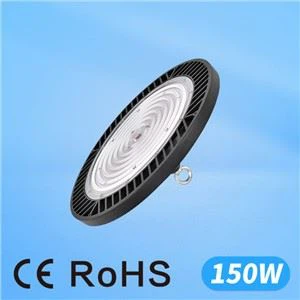

If your garage has a ceiling taller than about 20 feet - a detached workshop, an auto-repair bay, a tall residential garage, or a small commercial parking structure - a standard shop light will struggle to push enough light to the floor. That's where LED high bay lights come in. This guide is written from the perspective of a lighting engineer working through real selection decisions: how much light you actually need, what wattage fits your ceiling height, how to space the fixtures, and which fixture style suits your garage type.
It is not a top-10 list of products dressed up as a comparison. It's the same checklist we walk through with customers before we recommend a specific SKU.
What Are LED High Bay Garage Lights?
A high bay light is a fixture designed for ceilings roughly 20 to 45 feet high. At those heights, light has to travel further, so the optics are tighter and the lumen output is much higher than a regular garage light or shop light. LED versions have largely replaced metal halide and T5/T8 fluorescents because they reach full brightness instantly, use 40–60% less energy for the same lumen output, and don't need bulb changes every couple of years.
Two body styles dominate the garage market: round UFO high bays (compact, single-piece aluminum housings) and linear high bays (long rectangular fixtures that resemble fluorescent strips). They distribute light differently, which matters more than most buyers realize - we'll come back to that.
If you're still deciding whether you need a high bay at all, the threshold rule of thumb is in our breakdown of high bay vs. low bay lighting.
How Many Lumens Do You Need for a Garage?
Lumens - not watts - tell you how bright a fixture actually is. For garages, the Illuminating Engineering Society recommends roughly:
- Residential garage / storage: 30–50 foot-candles (about 300–500 lux) at the floor.
- General mechanical work, hobby workshop: 50–75 foot-candles (500–750 lux).
- Detailed inspection, auto body / paint booth prep: 75–100+ foot-candles (750–1000+ lux).
A quick way to estimate total lumens needed: multiply garage square footage by the target foot-candles, then divide by a light-loss factor of about 0.7 to account for fixture dirt, reflectance, and lumen depreciation over time.
Example: A 30 ft × 40 ft (1,200 sq ft) workshop targeting 75 foot-candles needs roughly 1,200 × 75 ÷ 0.7 ≈ 128,500 lumens total. That's typically four to six high bay fixtures, depending on wattage.
If you're converting from old wattage thinking - for example, planning to replace 400W metal halides - see our lumens-to-watts conversion chart before you size the LED replacement.
Recommended Wattage by Ceiling Height
Mounting height changes everything. The same fixture that perfectly lights a 15 ft ceiling will leave dark spots and shadows at 25 ft. As a starting point for a typical garage with light-colored walls and an efficient 130–150 lm/W fixture:
| Ceiling Height | Suggested Fixture | Approx. Lumens per Fixture | Typical Use Case |
|---|---|---|---|
| 12–15 ft | 100W LED high bay | 13,000–15,000 lm | Residential garage, small workshop |
| 15–20 ft | 150W LED high bay | 19,500–22,500 lm | Two- to three-car garage, light commercial |
| 20–25 ft | 200W LED high bay | 26,000–30,000 lm | Auto repair shop, mid-size commercial garage |
| 25–35 ft | 240–300W LED high bay | 32,000–45,000 lm | Commercial garage, large workshop, warehouse-style garage |
| 35–45 ft | 400W LED high bay or pair of 240W | 50,000+ lm | High-ceiling industrial garage |
These are starting points, not guarantees - the right answer depends on garage dimensions, target foot-candles, fixture beam angle, and wall reflectance. For high-ceiling commercial applications, a full lighting calculation using IES files in software like DIALux or AGi32 is worth the effort.

UFO vs. Linear High Bay Lights for Garages
This is the choice most buyers get wrong. Both deliver the same total lumens for a given wattage, but they spread light very differently.
- UFO high bays produce a roughly circular pool of light, typically with a 90°–120° beam angle. They're ideal when ceilings are square or evenly spaced overhead, and they're easier to install on a single hook or chain. Best for open garages, parking bays, and most residential workshops. Our UFO LED high bay range covers 100W to 240W versions for these scenarios.
- Linear high bays throw light in a rectangular pattern, which suits long, narrow garages, aisles between car lifts, or work benches against a wall. They typically distribute light more evenly across a row of work areas.
For a more detailed side-by-side, including efficacy, glare control, and installation differences, see our comparison of UFO high bay vs. linear high bay fixtures.

How to Space High Bay Lights in a Garage
Spacing is what separates an evenly lit garage from one with bright pools and dim corners. A practical rule:
Spacing between fixtures ≈ mounting height × 1.0 to 1.5 (use 1.0 for high-precision work areas, 1.5 for general garage lighting).
So at a 20 ft mounting height, fixtures should sit roughly 20–30 ft apart on center. The distance from any fixture to the nearest wall should be about half that - typically 10–15 ft. Linear high bays usually allow slightly wider spacing along their long axis. For a deeper walkthrough including overlap calculations, see our full guide on how to space high bay lights.

Best LED High Bay Lights for Different Garage Types
Residential Garage (12–15 ft ceiling, 2–3 car bay)
One or two 100W UFO high bays with a 5000K daylight color temperature usually do the job. Look for a CRI of 80 or higher so paint colors and labels look natural, and a frosted lens if you spend time working directly under the fixture (it softens glare).
Hobby Workshop or Detached Garage (15–20 ft, large workbench)
Two to four 150W UFO or linear high bays, again at 5000K. Add a dimmable driver if you want to drop output for video shoots, photo work, or evening use. A motion sensor on at least one fixture is worth the small upcharge.
Auto Repair Shop or Service Garage (20–25 ft)
200W LED high bays at 5000K with high CRI (≥80, ideally 90 for color-critical work like paint matching). Plan for roughly one fixture per 200–250 sq ft. If you have a lift bay, consider linear high bays mounted parallel to the lift so light reaches under the vehicle from both sides.
Commercial Garage or Warehouse-Style Storage (25–35+ ft)
240–300W fixtures with a narrower beam angle (60°–90°) to concentrate light at floor level. DLC Premium-listed products are usually required for utility rebate eligibility. For aisle-heavy layouts, linear high bays often win - there's more on this in our guide to linear LED high bays.
What to Look for Before You Buy
A short checklist worth running through before committing to any fixture:
- Efficacy: Aim for 130 lm/W or higher. Below 110 lm/W is outdated technology.
- CCT (color temperature): 4000K (neutral white) for relaxed home garages; 5000K (daylight) for workshops and commercial use.
- CRI: 80+ for general work; 90+ for paint, color matching, and detail inspection.
- Beam angle: Wider (120°) for low ceilings and even coverage; narrower (60°–90°) for tall ceilings.
- IP rating: IP65 if your garage gets dusty, damp, or sees pressure-washing.
- UL listing: Verify directly in UL Product iQ - many low-cost imports claim "UL certified" without an actual UL file number.
- DLC qualification: Required by most utility rebate programs. Check the model on the DLC Qualified Products List before assuming a rebate is available.
- Warranty: Five years is standard for reputable industrial-grade fixtures; one or two years suggests cut corners.
- Dimming and controls: 0–10V dimming is the most common standard. Motion sensors and daylight harvesting pay back quickly in commercial spaces.
If you want a longer, model-by-model walkthrough of these criteria, our buyer's guide to choosing the right high bay covers it in detail.
FAQ
Q: How many high bay lights do I need for a 2-car garage?
A: A standard 20 ft × 20 ft (400 sq ft) two-car garage with a 10–12 ft ceiling usually doesn't need a true high bay - a low bay or shop light is more efficient. If the ceiling is 14 ft or taller, one or two 100W LED high bays at 5000K will deliver roughly 75 foot-candles, suitable for everything from parking to light mechanical work.
Q: What wattage LED replaces a 400W metal halide high bay?
A: A 150W LED high bay producing around 20,000 lumens reliably replaces a 400W metal halide that produces about 22,000 initial lumens and degrades quickly. The LED version uses about 60% less energy and maintains output for far longer.
Q: Is 5000K too bright for a residential garage?
A: 5000K isn't about brightness - it's about color appearance. It looks cool/blueish and matches midday sunlight. Many homeowners prefer 4000K (closer to a clean white) for garages attached to the house, and 5000K for detached workshops where they want maximum visual clarity.
Q: Do I need a DLC-listed fixture?
A: Only if you want a utility rebate or are working under an energy-efficiency program that requires it. DLC listing is also a useful third-party check on efficacy, lumen maintenance, and warranty claims, so even outside rebate programs it's a reasonable filter for shortlisting quality fixtures.
Q: Can LED high bays be installed in a garage with high humidity or dust?
A: Yes, but specify an IP65-rated housing and an enclosed driver. Open-style high bays designed for clean indoor warehouses will fail prematurely in damp or dusty conditions.
Q: How high can I mount a 200W LED high bay?
A: Roughly 20–25 ft for general garage lighting at around 50–75 foot-candles. Above 25 ft, step up to 240W or use a narrower beam angle to maintain floor-level brightness.
Summarize
Pick wattage by ceiling height. Pick lumens by floor area and the kind of work you do. Pick UFO or linear by garage shape. Verify UL and DLC listings on the official databases - not on the seller's product page. And don't pay for marketing claims that aren't backed by a spec sheet, a real CRI number, and a warranty you'd actually want to use.
Get those five things right and almost any reputable LED high bay will perform well in a garage - regardless of which model you eventually buy.