If you are trying to light a large warehouse bay, cover an outdoor parking area after dark, or brighten a high-ceiling production floor, a standard LED bulb probably will not cut it. You need something with significantly more output - what the industry calls a high lumen LED bulb.
But here is where many buyers go wrong: they search for the brightest option they can find, assume more lumens automatically means better lighting, and end up with glare, wasted energy, or a bulb that does not fit the fixture. Brightness is only useful when it matches the space. The real question is not "What is the brightest bulb available?" - it is "How much usable light does this specific area actually need?"
In our experience helping facility managers and project engineers select industrial lighting, the most common mistake is skipping that question entirely. This guide walks you through when high-output LEDs make sense, when they do not, and how to make a selection that actually improves the space.

What Counts as a "High Lumen" LED Bulb?
There is no universal lumen threshold that separates a standard LED from a high lumen one. The term is relative to the product category and application. A 3,000-lumen bulb would be exceptionally bright in a bedroom but modest in a 25-foot-high warehouse aisle. A 20,000-lumen fixture is overkill for a hallway but appropriate for an outdoor security perimeter.
As a rough guide, most lighting professionals consider LEDs producing above 4,000 lumens to be "high lumen" in commercial contexts, while industrial and outdoor applications often call for 10,000 to 50,000+ lumens per fixture. The U.S. Department of Energy's Lighting Facts guidance reinforces that lumens - not watts - are the correct way to evaluate brightness, because wattage only tells you how much energy a bulb consumes, not how much visible light it produces.
If you are still thinking in watts, our lumens-to-watts conversion chart can help you translate. But the key takeaway is simple: always start with the lumen requirement of your space, not the wattage rating on the box.
Lumens vs. Watts: Why This Distinction Matters More Than Ever

For decades, people bought light bulbs by wattage. A 100-watt incandescent was "bright," a 60-watt was "normal." That mental model breaks down completely with LEDs. A modern LED producing 1,600 lumens - roughly equivalent to that old 100W incandescent - draws only about 10 to 15 watts. At the industrial end, a 200-watt LED fixture can produce 30,000 lumens or more, depending on the chip efficiency and optical design.
The DOE has been clear on this point: buyers should compare lumens, not watts, when evaluating brightness. Wattage cannot even reliably compare two LED products against each other, since efficacy (lumens per watt) varies significantly across manufacturers and product lines. Today's best commercial LEDs achieve 130 to 180 lm/W, with the DOE's long-term research targets aiming for 250+ lm/W in integrated lighting products.
For a deeper understanding of how lumens, lux, and watts interact in real-world lighting decisions, our guide on choosing lighting by lumen, lux, and watt breaks it down further.
When High-Output LEDs Are the Right Choice?
Higher-lumen LED fixtures earn their place in specific conditions. If your space meets one or more of the following criteria, a standard-output bulb is likely insufficient.
Large Commercial or Industrial Spaces

Warehouses, distribution centers, manufacturing floors, and large retail environments all demand strong, uniform illumination across wide areas. According to IES (Illuminating Engineering Society) recommended practices for industrial facilities, warehouse lighting targets typically range from 10 to 50 foot-candles depending on the task - with active picking and packing zones requiring 30 to 50 fc, and bulk storage areas needing 5 to 10 fc.
To put that in practical terms: a 20,000-square-foot warehouse with 20-foot ceilings and active picking operations might need fixtures delivering 10,000 to 20,000 lumens each, spaced according to beam angle and mounting height. In one facility upgrade we worked on, replacing aging 400W metal halide fixtures with 150W LED high bays (producing roughly 22,000 lumens each) raised average floor illuminance from about 18 fc to 38 fc - while cutting energy use by over 60%.
If you are planning a warehouse project, our warehouse lighting requirements guide covers the specifics. For fixture selection, see our overview of LED high bay types.
Outdoor Areas Where Visibility Equals Safety

Parking lots, loading docks, site perimeters, and walkways need higher output because of longer throw distances and the near-total absence of ambient light after sunset. IES guidelines for open parking lots recommend a minimum horizontal illuminance of 0.2 to 1.0 fc depending on the security level, with parking structures requiring 5 fc or more. In practice, smaller lots often need fixtures in the 12,000 to 18,000 lumen range, while larger commercial areas may call for 20,000 to 30,000+ lumens per pole.
Outdoor applications also benefit from IP-rated fixtures that resist moisture and dust. Our outdoor luminaire selection guide covers weather resistance, mounting options, and light distribution patterns for exterior installations. If you are comparing fixture types, our article on wall packs vs. floodlights explains which form factor suits different outdoor scenarios.
High Ceilings and Task-Critical Environments
The higher the mounting point, the more lumens you need to deliver adequate light at floor level. At 15 feet, a 100W LED high bay might provide sufficient illuminance for general storage. At 25 to 30 feet, you may need 200W or more to maintain the same foot-candle levels at the work plane. This is not just about raw output - beam angle becomes critical at greater heights, since a wider beam spreads light over a larger area but reduces intensity at any single point.
In task-critical environments like inspection stations, loading areas, and assembly lines, insufficient lighting is not just uncomfortable - it is a safety risk. OSHA's general industry standards reference adequate lighting as a workplace safety requirement, and IES RP-7 provides specific illuminance targets for industrial tasks ranging from rough work (10-20 fc) up to fine detailed inspection (50-100 fc).
When Brighter Is Not Better
Not every space benefits from a high-output LED. In many cases, too much light creates problems that are just as real as too little light.

Small Rooms and Low Ceilings
In a compact office, break room, or residential space with 8-to-10-foot ceilings, a bulb producing 5,000+ lumens will almost certainly cause discomfort. The light has nowhere to spread, surfaces reflect too much of it back, and occupants experience glare and visual fatigue. For these spaces, 800 to 3,000 lumens is typically appropriate - consult our guide on how many lumens you need for different spaces for specific room-by-room recommendations.
Hospitality, Retail Ambiance, and Comfort-Focused Spaces
In dining areas, hotel lobbies, and any environment where mood matters more than task visibility, lighting quality outweighs quantity. Color temperature (measured in Kelvin), dimming capability, and how light is layered across the space are more important than raw lumen counts. Warmer color temperatures (2700K to 3000K) create a relaxing atmosphere, while cooler temperatures (4000K to 5000K) improve contrast and alertness - which is why the DOE notes that cooler light is often preferred for task-intensive environments.
Glare-Prone Environments
A high-lumen bulb in the wrong fixture can make a space worse, not better. If the fixture has no proper lens, reflector, or shielding, concentrated light creates glare - especially on reflective floors, polished surfaces, or in spaces where people look upward frequently. This is a common issue we see in retrofit projects: someone installs a powerful corn bulb into an existing open fixture, and the result is bright but painfully uncomfortable. Better distribution, not just more output, is usually the fix.
How to Choose the Right High Lumen LED: A Step-by-Step Approach?
Picking the right high-output LED is not about finding the highest lumen number - it is about matching the fixture to the space. Here is how to think through it systematically.
Step 1: Define the Space, the Task, and the Target Illuminance
Before looking at any product specs, answer three questions: What is the space used for? How large is it? What illuminance level does it need?
For reference, here are common IES-recommended foot-candle ranges:
| Application | Recommended Foot-Candles | Typical Lumen Range per Fixture |
|---|---|---|
| Warehouse - inactive storage | 5–10 fc | 5,000–10,000 lm |
| Warehouse - active picking/packing | 30–50 fc | 15,000–30,000 lm |
| Manufacturing - general | 30–50 fc | 15,000–25,000 lm |
| Manufacturing - fine detail work | 50–100 fc | 20,000–40,000+ lm |
| Open parking lot | 0.2–1.0 fc (min.) | 12,000–30,000 lm |
| Parking structure | 5 fc | 8,000–15,000 lm |
| Retail - general floor | 30–50 fc | 10,000–20,000 lm |
| Office - general | 30–50 fc | 3,000–5,000 lm |
Note: Lumen ranges per fixture are approximate and depend on mounting height, spacing, beam angle, and room reflectance. Always verify with a photometric layout for critical installations.
Step 2: Match the Product Type to the Application
High lumen LEDs come in several form factors, and picking the wrong type is a common mistake:
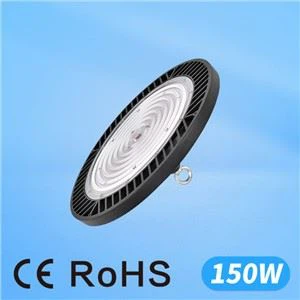
- UFO high bay lights - Compact, round fixtures ideal for warehouse and industrial ceilings at 15 to 40+ feet. They typically produce 10,000 to 40,000 lumens. See our UFO high bay selection guide for details.
- Linear high bay lights - Longer fixtures suited to aisle-oriented spaces, providing more even side-to-side distribution. Good for warehouses with racking systems.
- LED floodlights - Designed for wide-area outdoor coverage: parking lots, building facades, sports courts, and security lighting. Output ranges from 10,000 to 50,000+ lumens. Our comprehensive floodlight guide covers beam angles, mounting, and application planning.
- LED area lights - Pole-mounted fixtures for parking lots, roadways, and campus lighting. Broader distribution than floodlights, with built-in cutoff to reduce light trespass. Learn more about outdoor area lighting.
- Corn bulb LEDs - Retrofit lamps that screw into existing E26/E39 sockets. Convenient for upgrades, but check thermal compatibility - many enclosed fixtures trap heat and shorten LED life.
Step 3: Evaluate Beam Angle and Light Distribution

A 20,000-lumen fixture with a narrow 60° beam angle concentrates light into a tight cone - great for high ceilings directly above a work station, but terrible for general area coverage. A 120° beam angle spreads light more evenly but delivers lower peak intensity. For warehouse aisles, 90° to 120° is typical. For focused task areas, 60° to 90° works better. For outdoor floodlighting, wider distributions (120°+) help eliminate dark spots between poles.
Understanding the difference between floodlights and spotlights is also critical when planning outdoor installations.
Step 4: Get Color Temperature and Dimming Right
Color temperature affects visibility, comfort, and how a space feels. For most industrial and outdoor applications, 4000K to 5000K (neutral to cool white) provides the best contrast for visual tasks. Retail and hospitality environments usually perform better at 3000K to 3500K. If you need flexibility - say, a multipurpose facility that serves as both a workspace during the day and an event space at night - dimming capability is essential.
Make sure the LED driver and any dimmer or control system are compatible. Mismatched dimming components cause flickering, buzzing, and premature failure. The DOE's purchasing guidance for luminaires stresses that dimming behavior, flicker, and heat management in enclosed fixtures are critical compatibility factors.
Step 5: Verify Fixture Compatibility and Operating Conditions

This step gets skipped more than any other - and it is where many installations fail. Before purchasing, confirm:
- Enclosed fixture rating: Not all high-output LEDs are rated for enclosed fixtures. Trapped heat degrades LED chips and drivers, cutting lifespan dramatically. Look for fixtures specifically rated for enclosed or sealed environments.
- Operating temperature range: LEDs lose efficacy at high ambient temperatures. If your space regularly exceeds 40°C (104°F), choose fixtures designed for high-temperature environments.
- IP rating: Outdoor and washdown areas need at least IP65. Dusty industrial environments benefit from IP65 or higher even indoors.
- Certifications: UL, DLC, or Energy Star listing provides third-party verification of performance and safety. DLC-listed products also qualify for many utility rebate programs.
Comparison: Where High Lumen LEDs Fit - and Where They Do Not
| Scenario | Good Fit? | Recommended Approach |
|---|---|---|
| 40,000 sq ft warehouse, 24 ft ceilings | Yes | 200W LED high bays at 28,000–36,000 lm, spaced per photometric plan, 4000K–5000K |
| Outdoor parking lot, 60 spaces | Yes | LED area lights or floodlights at 20,000–30,000 lm per pole, 4000K–5000K, IP65+ |
| Retail showroom, 12 ft ceilings | Depends | Mix of high-output downlights for feature displays and moderate-output ambient fixtures, 3000K–3500K |
| Small office, 9 ft ceilings | No | Standard LED troffers or panels at 3,000–5,000 lm, 3500K–4000K |
| Restaurant dining area | No | Dimmable fixtures at 1,500–3,000 lm, 2700K–3000K, layered with accent lighting |
| Loading dock with 18 ft clearance | Yes | LED high bays at 15,000–22,000 lm, 5000K for task clarity, IP65 if exposed to weather |
Common Mistakes We See in High Lumen LED Projects

Installing high-output corn bulbs in enclosed residential fixtures.
We have seen homeowners and small business owners install 5,000+ lumen corn bulbs in enclosed porch lights or jelly-jar fixtures. The fixture traps heat, the driver overheats, and the bulb fails within months. If you are upgrading an enclosed fixture, check that the LED is specifically rated for enclosed use - or better yet, replace the entire fixture with one designed for LED. Our article on how long LEDs really last explains how heat management directly impacts lifespan.
Overlighting low-ceiling spaces.
A common scenario in facility upgrades: the maintenance team installs 30,000-lumen fixtures in an 8-foot-ceiling break room because "brighter is better." The result is a room so harsh that employees avoid using it. Calculating the actual foot-candle requirement first would have pointed them to a 3,000 to 4,000 lumen fixture instead.
Ignoring beam angle and uniformity.
Five high-lumen fixtures in a parking lot mean nothing if the beam angles leave dark gaps between poles. Uniformity - the ratio between the brightest and dimmest spots in a space - matters as much as average illuminance. IES guidelines for parking areas recommend a maximum-to-minimum uniformity ratio of 15:1 or better for enhanced security zones. A photometric layout, which any reputable lighting supplier can provide, identifies these gaps before installation.
Forgetting about total cost of ownership.
A cheaper high-lumen fixture with 100 lm/W efficacy will cost more to operate over five years than a higher-quality fixture at 150 lm/W. Factor in energy cost, maintenance, and any available utility rebates when comparing options. Our overview of the advantages and trade-offs of LED lighting helps frame this calculation.
Frequently Asked Questions
How many lumens is considered "high" for an LED bulb?
It depends on the application. In residential settings, anything above 2,000 lumens is relatively high. For commercial and industrial use, "high lumen" typically starts at 4,000 to 5,000 lumens and can extend to 50,000+ lumens for large high bay or outdoor fixtures. The label is relative - what matters is whether the lumen output matches the illuminance requirement of the space.
Can I just replace my old bulb with a higher-lumen LED in the same fixture?
Sometimes, but not always. You need to verify that the existing fixture can handle the heat generated by a higher-output LED. Enclosed fixtures are especially risky because they trap heat, which degrades the LED driver and chips. Also check the socket type (E26, E39, GU24, etc.) and whether the fixture's wiring and ballast are compatible. For major upgrades, replacing the entire fixture often makes more sense than retrofitting. See our tips on industrial lighting retrofits.
What color temperature should I choose for a high lumen LED?
For warehouses, parking lots, and task-heavy environments, 4000K to 5000K provides the best contrast and visual acuity. For retail spaces, 3500K to 4000K balances task visibility with a welcoming feel. For hospitality and comfort-driven areas, 2700K to 3000K is standard. If you need to switch between modes, choose a fixture with tunable white or dimming capabilities.
How do I know how many lumens my space needs?
Start with the IES-recommended foot-candle level for your application (see the table above). Then multiply by the square footage to get total lumens needed. Divide by the number of planned fixtures to get your target lumens per fixture. For example, a 10,000 sq ft warehouse area needing 30 fc requires approximately 300,000 total lumens. With 15 fixtures, each needs to deliver about 20,000 lumens. Adjustments for mounting height, reflectance, and light loss factor will refine this number - which is why a photometric layout is recommended for any project over a few fixtures.
Are high lumen LED bulbs more expensive to run?
They consume more watts than lower-output LEDs, so yes, the per-fixture energy cost is higher. However, modern high-output LEDs are far more efficient than the HID, metal halide, or fluorescent fixtures they typically replace. A 200W LED producing 30,000 lumens replaces a 400W to 1,000W legacy fixture while delivering equal or better illumination. The net result is usually a significant reduction in total energy costs. Our guide to choosing the right LED fixtures includes efficiency comparisons to help you plan.
Bottom Line
High lumen LED bulbs solve real problems - but only when matched to the right environment. Start with the space and the task, not the spec sheet. Calculate the foot-candle level you need, choose the right fixture type for your mounting height and coverage area, and verify compatibility before you buy. That process, rather than chasing the highest lumen number on the shelf, leads to lighting that actually performs.
If you are working on a warehouse, parking lot, industrial facility, or any high-demand lighting project, reach out to our team for a photometric layout and product recommendation tailored to your space.